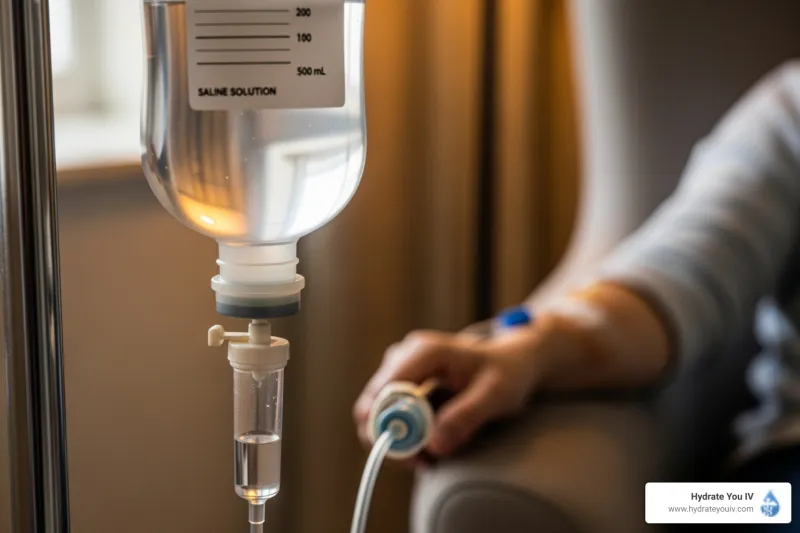
What Is That Sound? A Calm Listener’s Guide to IV Equipment
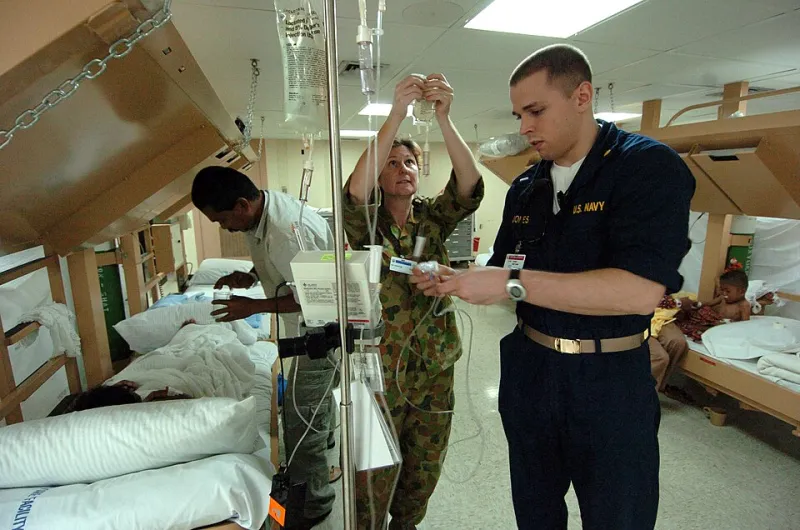
Photo: U.S. Navy photo by Photographer's Mate 3rd Class Rebecca J. Moat, Public domain, via Wikimedia Commons
An IV appointment has a soundtrack. There is the soft click of a pump being programmed, the tick of a roller clamp, the brief chirp when a bag is spiked, and sometimes a beep that makes everyone in the room look up. If you are new to IV therapy, those sounds can feel more medical than the treatment itself. They do not have to. Most of the noise is housekeeping—equipment confirming a setting, a nurse making an adjustment, a pump reporting that it has finished a job. Learning the difference between background chatter and a sound that deserves a hand raise is one of the simplest ways to feel more at ease in the chair.
The Normal Noise Floor
Clinics are full of small sounds that have nothing to do with a problem. A volumetric pump may click as its cassette seats or as the machine delivers fluid in tiny measured pushes. A syringe pump may whir softly and then pause. The IV pole may creak when a bag is hung. A nurse may open a package, snap a cap, or tap a screen. None of that is a warning.
Gravity drips have their own quiet rhythm. If your clinic uses a gravity setup instead of a pump, you may hear nothing at all except the faint drip in the chamber and the ordinary sounds of the room. That is normal too. The presence or absence of a pump is not a measure of how serious your treatment is. It is just a different way of controlling the flow.
At Infusion Wellness, we think of these sounds the way you might think of the hum of a refrigerator: noticeable when you listen for it, easy to ignore once you know it is doing its job.
The Beep Has a Job Description
Pump alarms are not random. They are the machine’s way of saying it has noticed something and has either paused or is asking for a human to check. The most common alerts are practical, not dramatic.
A completed-infusion alert usually means the programmed volume has finished. Some pumps then switch to a keep-vein-open rate, which is a slow trickle designed to keep the line from clotting until a nurse disconnects you. A low-battery alert means the pump wants to be plugged in. A door-open or cassette alert means the tubing or cartridge is not seated the way the machine expects. An air-in-line alert means a sensor detected air where it does not want it; the pump stops so a nurse can check the line. An occlusion alert means the pump senses resistance—sometimes a kinked tube, sometimes a clamped line, sometimes an arm position that has narrowed the flow.
That is the useful reframe: the pump is not grading your health. It is reporting on the plumbing and the programming. A beep is not a diagnosis.
Upstream, Downstream, and Other Plumbing Words
If you hear a nurse say upstream occlusion, they usually mean the problem is between the bag and the pump—a closed clamp, an empty bag, or tubing that is pinched. Downstream occlusion usually means the problem is between the pump and your vein—a bent catheter, a kinked line, or a position that needs adjusting. You do not need to memorize the vocabulary. It helps only to know that these are mechanical checks, not emergency announcements.
Air-in-line alarms can sound more alarming than they are. Modern pumps have sensors designed to catch small amounts of air and stop the infusion so a nurse can remove it or reset the line. The machine is being cautious. The nurse is the one who decides what the sensor’s message actually requires.
Reading the Alarm Without Becoming an Alarmist
Alarm fatigue is real. In a busy clinic, beeps can blend into the background, and patients may either ignore every sound or tense up at every chirp. Neither response is necessary. A better approach is to listen for changes.
Did the pump beep once when the nurse pressed start? Routine. Did it beep once at the end of the bag? Expected. Is it beeping in a repeating pattern while no one comes? That is worth a look. Is the sound paired with something you feel—burning, stinging, swelling, tightness, or a cool sensation around the IV site? That is worth a hand raise. Is the alarm happening again and again after a nurse has already reset it? Also worth mentioning.
You are not the clinic’s alarm system, and you do not need to monitor the pump for a living. But you are the only person in the chair who can feel what the machine cannot. That makes your observations useful.
Sounds That Deserve a Hand Raise
Most beeps resolve in seconds. The ones that deserve attention are usually the ones that repeat, escalate, or arrive with a physical symptom. Flag it if the pump keeps alarming after a reset, if no one has checked on a persistent alarm, or if you feel pain, burning, swelling, redness, or coolness at the IV site. Flag it if you feel short of breath, chest pain, faint, itchy, or generally wrong—regardless of what the pump is doing. Those are not equipment sounds. They are your body’s sounds, and they outrank the machine.
You can also flag a sound simply because it is new to you. Curiosity is allowed. A good clinic would rather answer a question than have you white-knuckle your way through a routine appointment.
What to Say When You Want a Translation
You do not need technical language. Try: 'What is that alarm telling you?' 'Is that expected for this drip?' 'Could you check the site while you are here?' 'Is the pump supposed to be beeping like that?' These questions are calm, specific, and easy to answer. They also give the nurse permission to explain rather than just silence the machine.
One small note: silencing an alarm is not the same as solving the issue. A good nurse may press pause to think, but they should still check the line, the site, and the settings. If an alarm is dismissed without a look, it is fair to ask for one.
Leaving With Your Ears—and Nerves—Intact
The sounds of an IV appointment are mostly the sounds of a system doing its job: measuring, delivering, pausing, reporting. You do not have to love the beeps. You just do not have to fear them by default. Learn the normal noise, notice what changes, and speak up when the sound and your body disagree with the room’s calm. That is not being a difficult patient. It is being a literate one.